John Grote, Cambridge University and the Development of Victorian Thought by John Richard Gibbins
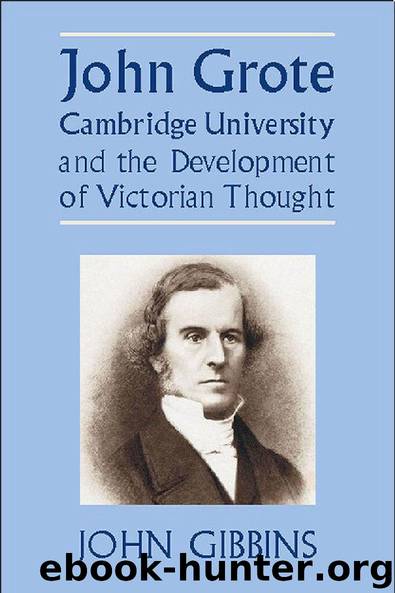
Author:John Richard Gibbins
Language: eng
Format: epub
Tags: Philosophy, sectarianism, Cambridge, British Idealism, language, knowledge, ethics, politics, liberalism, epistemology, ontology, morality, mind, ethics, utilitarianism, jural ethics, John Grote
ISBN: 9781845407346
Publisher: Andrews UK Limited 2013
Published: 2013-10-07T00:00:00+00:00
The Moral Scale of Sensation and Knowledge
The illustration given by Grote refers to the two axioms of Aretaics and Eudaemonics referred to earlier. In everyday life humans experience sensations of pleasure and pain. By themselves their immediate experiences are of no moral significance but once subjected to reflective judgement in social discourse, a number of possible moral principles may emerge, to be argued over and fixed for a society. The eudaemonic ideal, that we ought not to suffer pain and ought to experience pleasure, is an ideal fixed after reflective judgement and conversation on our immediate experiences.
But from the same immediate experiences, active creative and social beings may equally well conclude that pain ‘is what should not be inflicted on others’. This is the aretaic first principle which arises from a different thinking process but based on the same immediate sensations and experiences. These principles may be seen as complementary or, if in conflict, they must be treated as competitors for our rational allegiance. According to Grote, moral feelings, imperatives, ideals, rules and prescriptive principles are all as natural to us as ordinary sensations and knowledge. The idea that ideals belong to mind and sensations to the body, one to the subjective and the other to the objective, Grote rejects emphatically (Grote, 1876, 59). Nor are these ideals or imaginations ‘delusive’ or ‘dreams’ as positivists liked to insist. Rather they are refined intellectual judgements of a kind similar to scientific statements of truth and, as we shall see later, they also reflect and indicate at the same time the higher facts, the universal moral order of which as yet we have only glimpses, hopes and beliefs. Nor finally are they intuitions or moral axioms but are rather the formal postulates of the practice of morals at one level and the results of experience, practice and reflection on the other.
The issue now is the status of these beliefs in the higher facts. All science and all positivism are grounded on one fundamental postulate or belief, unprovable in principle, but without which science would be logically incoherent and practically impossible. This is the belief
in the universe: it is that belief that there is something to be known, which must accompany, more or less, every act of knowledge, or else I do not see how we could try to know anything… (1876, 64).
Later the fundamental postulate is described as
The belief that law and order, as opposed to chaos and randomness, must apply not only to the particulars of things, as we see it does, but to the entire of being, in which case it becomes meaning and reason, as distinguished from insignificance and purposelessness, - this belief seems to me to play the same part in the fragmentary and incohesive mass of circumstance or occasion for action, which we call life or the moral universe, as it does in the intellectual universe (1876, 373).
Without this belief Grote rightly sees that we could not speak of truth, we could not say we know or even try to know anything.
Download
This site does not store any files on its server. We only index and link to content provided by other sites. Please contact the content providers to delete copyright contents if any and email us, we'll remove relevant links or contents immediately.
Hit Refresh by Satya Nadella(9141)
When Breath Becomes Air by Paul Kalanithi(8451)
The Girl Without a Voice by Casey Watson(7892)
A Court of Wings and Ruin by Sarah J. Maas(7858)
Do No Harm Stories of Life, Death and Brain Surgery by Henry Marsh(6945)
Shoe Dog by Phil Knight(5274)
The Rules Do Not Apply by Ariel Levy(4974)
A Higher Loyalty: Truth, Lies, and Leadership by James Comey(4966)
Hunger by Roxane Gay(4931)
Tuesdays with Morrie by Mitch Albom(4790)
Everything Happens for a Reason by Kate Bowler(4746)
The Immortal Life of Henrietta Lacks by Rebecca Skloot(4593)
Millionaire: The Philanderer, Gambler, and Duelist Who Invented Modern Finance by Janet Gleeson(4482)
How to Change Your Mind by Michael Pollan(4360)
All Creatures Great and Small by James Herriot(4329)
The Money Culture by Michael Lewis(4212)
Man and His Symbols by Carl Gustav Jung(4140)
Elon Musk by Ashlee Vance(4130)
Tokyo Vice: An American Reporter on the Police Beat in Japan by Jake Adelstein(3998)
